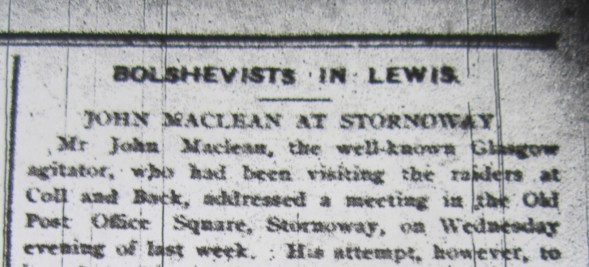
Tha dà chunntas againn an seo, bho sheallaidhean gu tur eadar-dhealaichte, air an òraid a thug Iain Mòr MacGillEathain (John Maclean, 1879-1923) seachad ann an Steòrnabhagh – ceud bliadhna air ais an-diugh, 4 Lùnastal 1920. Dh’fhaodadh nach eil fios aig mòran gun do thadhail an sòisealach Albannach a b’ ainmeile air an eilean no air a’ Ghàidhealtachd. Ach, thadhail gu dearbh, airson dlùth-chomann a shealltainn, agus ceangal a dhèanamh ri rèidearan Chol is Ghriais.
Agus thachair seo aig àm fìor inntinneach ann an eachdraidh phoileataigeach. Bha MacGillEathain dìreach air tilleadh à Èirinn a bha a’ dol tro Chogadh na Saoirse. Air an turas ud, bha e ag amas, mar a tha e ag innse gu h-ìseal;
to establish an entente between the Celts of Scotland and the Celts of Ireland, and to further my efforts to prevent Scottish boys being used by England to murder Irish boys.
Bha cho cudromach ’s a bha an strì Èireannach na chuid poileataigs a’ dol còmhla ri lèirsinn ùr air neo-eisimeileachd Albannach, agus cainnt air nithean ‘Ceilteach’ is Gàidhealach an lùib seasamh comannach eadar-nàiseanta. Tha seo uile ri fhaicinn anns an alt ‘The Highland Land Seizures’ (An t-Sultain 1920) a tha mi a’ sgaoileadh às ùr an seo. Bhruidhinn MacGillEathain mun Mhorair Leverhulme is toirt a-mach an fhearainn ann an Leòdhas cuideachd – coimeasgaichte leis na grìtheidean eile seo – ann an ‘Irish Stew’ (An Lùnastal 1920), ‘Scotch Broth’ (An t-Sultain 1920), agus fiù ’s san aithris chliùitich aige ‘All Hail, the Scottish Workers Republic!’ (An Lùnastal 1920).
Tha sinn fortanach gu bheil na h-altan seo le Iain Mòr MacGillEathain air-loidhne mar-thà. Airson barrachd fiosrachaidh agus coimeas a dhèanamh ri cunntas MhicGillEathain fhèin air an turas aige a Leòdhas, rinn mi tras-sgrìobhadh de dh’alt goirid a nochd anns an Stornoway Gazette mu dheidhinn (13 Lùnastal 1920).
Is lèir dhuinn cho nàimhdeil ’s a tha an Gazette ri MacGillEathain agus a h-uile rud a tha e a’ riochdachadh. ’S e ‘Clydeside demagogue’ a tha ann, làn ‘specious claptrap’. Thàinig e a bhruidhinn ri muinntir Steòrnabhaigh ‘to inoculate his audience with the virus of Bolshevism’. Cha mhòr nach cluinnear gàire an sgrìobhadair agus e ag innse mu na h-ionnsaighean a fhuair MacGillEathain bhon luchd-èisteachd Leòdhasach. Tha iad ga thoirt a-nuas bhon spiris aige, mar gum b’ eadh, agus cha mhòr ga fhògradh bhon cheàrnaig. Cho luath ’s a thòisich e air bruidhinn air Leverhulme agus a chuid sgeamaichean dh’fhàs fearg nan daoine a bha an làthair.
’S beag an t-iongnadh ged a bhiodh sin fìor. Bha an ceannard sòisealach seo dìreach air baile a ruigsinn a bha gu mòr a’ fulang ri linn co-dhùnadh Leverhulme sgur a phàigheadh luchd-obrach air na sgeamaichean aige – a’ gabhail a-steach ‘£3800 a week in wages alone’ a rèir a’ chuilbh-dheasachaidh – gus am fàgadh na rèidearan tuathanachas Chol is Ghriais. An àite a bhith feargach ri neach-fastaidh a dhèanadh a leithid de pheanasachadh coitcheann, b’ ann a dh’obraich an ro-innleachd seo mar bu chòir, le cuideachadh bhon Ghazette, gus muinntir an àite a thionndadh an aghaidh nan rèidearan.
Bha adhbhar eile aig an luchd-èisteachd a bhith tàrmasach mu Iain Mòr MacGillEathain. Bha cuid mhath dhiubh air a bhith san arm agus sa chabhlaich rè a’ chogaidh. Bha iad air tighinn tro uabhasan, air call cianail na h-Iolaire fhiosrachadh a’ bhliadhna roimhe, agus seo a-nis cuideigin a’ nochdadh a chuir seachad an cogadh a’ dian-obrachadh nan aghaidh, a’ càineadh nan luachan don robh iad a’ sabaid. Bhruidhinn corra shaighdear òg na aghaidh, aonan ag ràdh gun robh iadsan ‘fighting for him in France when he was cooling his heels in Peterhead Prison’. Bhiodh e dùbhlanach, ged nach robh e idir eu-comasach, airson an dà thaobh a bhith air an aon ràmh. Cha robh MacGillEathain riamh ‘cooling his heels’ sa phrìosan, ge-tà – b’ ann a fhuair e ciùrradh do-chreidsinneach a-rithist ’s a-rithist airson a’ chlas aige, agus an aghaidh casgairt nan dearbh shaighdearan sin.
Tha cunntas a’ Ghazette gu cinnteach taobhach agus a’ cur a ghleans fhèin air an tachartas. Ach, chan eil coltas ann gu bheil iad a’ dèanamh cus fiaraidh air faclan MhicGillEathain. Tha sinn ag aithneachadh nan cuspairean uile a tha iad ag ainmeachadh: strì na h-Èireann an aghaidh na h-Ìmpireachd; an càirdeas eadar Albannaich is Èireannaich – fiù ’s cho faisg ’s a bha Gàidhlig na dà dhùthcha; càineadh air a’ chalpaiche Shasannach, Leverhulme; agus an creideamh mearachdach a bha aige gun robh cogadh gu bhith eadar Breatann is na Stàitean Aonaichte, is gun robh sgeamaichean Leverhulme gu h-ìre ag ullachadh airson sin ann an ceàrnaidh ‘ro-innleachdail’.
Tha a’ chuimhne a tha aig MacGillEathain air an latha ud ann an Steòrnabhagh ag aontachadh ris na sgrìobh an Gazette san t-seagh gun robh luchd-èisteachd mosach fhèin aige agus daoine a’ cur stad air gun abhsadh. Dh’fhiosraich e gu math gun deach le Leverhulme ann a bhith ‘embittering Stornoway wage-slave working out his schemes, against the “raiders” at Coll and Gress by stopping work on roads at the proposed harbour extension’. Bhruidhinn grunn diofar dhaoine na aghaidh: ‘drunks who interjected under the protection of the police’, ‘an important and able personage’ – pàighte leis na h-ùghdarrasan? – agus seann daoine a bha gu mòr air taobh Leverhulme. Ach, eu-coltach ris a’ Ghazette, chùm MacGillEathain a-mach gun robh cuid de na daoine òga na bu bhuailtiche gabhail ri a theachdaireachd:
younger men are more inclined to hold Leverhulme in contempt, especially those who have lived abroad or in the rebellious atmosphere of Clyde valley.
Tha buaidh radaigeach Chluaidh air Leòdhasaich aig an àm ri faicinn ann an tùsan a tha mi air leughadh. Bha MacGillEathain cuideachd dhen bharail gun robh eagal air cuid san eilean a bhith a’ bruidhinn a-mach an aghaidh an uachdarain mhòir. Agus, ged nach eil iomradh aig a’ Ghazette air, bha e a’ smaoineachadh gun robh deagh choinneamh aige, agus aig a chomrannach Sandy Ross, a bha ann air thoiseach air, ri rèidearan Chol – ged nach robh ach ceathrar dhiubh comasach air a bhith ann. Cuimhnich gum b’ e seann saighdearan is mharaichean a bha anntasan cuideachd. (’S bochd nach eil an litir aca fhèin air a tras-sgrìobhadh an-dràsta air neo chluinneamaid bhuapa fhèin an seo.) Shoirbhich leis ann a bhith air dòigh le a bhith a’ dèanamh ceangal beag eile eadar luchd-obrach radaigeach Chluaidh agus rèidearan Gàidhealach. Bha a làthaireachd a-mhàin, agus mar a nochd i anns na pàipearan, a’ dèanamh puing shamhlachail agus phoileataigeach a dh’fhaodadh a bhith air a daingneachadh le tuilleadh aonachd mhìleantach eadar Gàidhealtachd is Galltachd.
Don Stornoway Gazette, cha robh ceist ann gun robh na rèidearan fada ceàrr. Sa cholbh-dheasachaidh aca san aon àireimh (13 Lùnastal) tha iad a’ bruidhinn air ‘the unfortunate state of affairs that have arisen in the island through the misguided – and illegal – action of a handful of men’. Bha iad a’ dèanamh dheth gun robh làn chead aig Leverhulme a bhith a’ sgur dhe a chuid sgeamaichean, agus bha iad dòchasach nuair a thigeadh Rùnaire na h-Alba, Robert Munro, don eilean – am fear a rinn cinnteach gun deach MacGillEathain don phrìosan rè a’ chogaidh – gum faiceadh iad cho ceàrr agus a bha iad.
A’ cur ìmpidh orra, tha iad cuideachd a’ toirt slaic eile air Iain Mòr MacGillEathain mar ghrìosaiche bhon taobh a-muigh (outside agitator), nach eil ann an da-rìribh coltach riutha no ri deagh eileanaich eile – tha iad an dòchas:
But, after all, we cannot think that the Lewis raiders will remain obdurate when they seriously reflect on the consequences of their attitude to the Island of Lewis now and in the future. The forthcoming visit of the Secretary for Scotland will bring to the men of Coll and Gress a golden opportunity of proving themselves not small and selfish men but big men and patriotic islanders, capable of sinking their own personal and immediate interests in favour of the interests of their fellow Lewismen as a whole. After all these men of Coll and Gress, like all Lewismen, are loyal to their King and Country. They have reverence for the faith of their fathers[,] and are not of the Bolshevis[t] type of which John Maclean, who visited them recently, is a sample.
~~~
BOLSHEVISTS IN LEWIS
JOHN MACLEAN AT STORNOWAY
Mr John Maclean, the well-known Glasgow agitator, who had been visiting the raiders at Coll and Back, addressed a meeting in the Old Post Office Square, Stornoway, on Wednesday evening of last week. His attempt, however, to inoculate his audience with the virus of Bolshevism was not so successful as doubtless he had anticipated it would be. At an early stage in his harangue it became clear that the young ex-service men present “had his number.” They listened patiently enough to his disquisition on the kinship of the Keltic races, and the similarity between Scotch and Irish Gaelic, though they did not quite follow his argument that this was a reason why we should take sides with Sinn Fein against “England.” When he came to deal with Lewis local affairs, he found himself on distinctly thorny ground, and the reception accorded his first reference to Lord Leverhulme warned him that he had struck a jarring note. From this point onwards the hostility of the audience became more pronounced, and towards the end of his speech the feeling was strongly antagonistic.
Mr Maclean found occasion to inform his hearers of the great part he had played in the world-wide Bolshevik movement, and treated us to a few of his predictions which he claimed had “come off.” Seeing he is by the way of being a prophet, it may be as well to put on record his prediction that the next war will be between this country and America, and that it will arise over the competition of the oil fields of the world. Lord Leverhulme will be interested, not to say amused, at the fantastic explanation given by Mr Maclean of his reason for purchasing the Island of Lewis, and developing it. It seems after all – if we can believe this Clydeside demagogue – that the proposed extension of the harbour at Stornoway for fishing purposes is merely camouflage, as, of course, is also the construction of a new harbour at Obbe in Harris. The true reason, we are asked to believe, is that all this development is in anticipation of the next great war which – being between this country and America – will make the Hebrides of supreme importance strategically! This also is Mr Maclean’s explanation of the formation of fishing companies at Tobermory and Stranraer!
One young ex-soldier, nettled by the speaker’s glorification of Lenin and Trotsky and his German socialist friends carried the meeting with him when he told the speaker that they were fighting for him in France when he was cooling his heels in Peterhead Prison. The sally was not appreciated by Mr Maclean, who later complained of the remark of another soldier that he (Mr Maclean) was the friend of every country but his own, which, he said, was a cute move to turn the feeling of the meeting against him.
At the close of his address questions were invited and quite a number were put. In fact Mr Maclean complained that he could not get a chance to answer one question before another was put. He evidently got alarmed at the growing hostility, remarking he as never afraid to give expression to his views anywhere or at any time, but if any violence was shown towards him it would not be to the credit of Stornoway. The opposition he had met with was not to his liking. He characterised it as not fair, not courteous and not Highland. It was, however, a reflex of his audience’s “appreciation” of the specious claptrap with which he hoped to gull them.
Tùs: Stornoway Gazette and West Coast Advertiser (Friday, August 13, 1920).
Air a thras-sgrìobhadh le T. MacAilpein.
*****
The Highland Land Seizures
by John Maclean
The crofters’ agitations for land have been for two generations met in the usual way the granting of inoperative Acts. Of course, when the government required strong and fearless Highlanders to die for English landlords like the Duke of Northumberland or capitalists like Lord Leverhulme, promises of land were made to the fisher-crofters, as an earthly paradise was promised the empire’s wage-slaves, and a measure of self-government to Ireland and India.
Not one promise has been kept. India has got an “ Amritsar”, Ireland an “army of anarchy”, and Lewis a “Sunlight Soap dictator”.
In the Highlands the Board of Agriculture’s failure to keep its land promises to what I think were misguided patriots led to the seizures of farms by the desperate ex-service crofters. More of these seizures are likely to take place unless “my friend”, Mr Robert Munro (the Highland traitor who got me a three years’ sentence for resisting the Conscription Act of the Germans of England) smartens up a bit, or clears out like the other Celtic traitor, Ian MacPherson, the late dictator over the Irish Celts on behalf of the Sassenachs.
The chief farms seized have been Kirkton Farm, Portskerra, Sutherlandshire; the home farm, Raasay Island; and Coll and Gress farms, Lewis.
As the Lewis raids were the most important from a Scottish independence and a world political point of view, it was agreed that Sandy Ross and Peter Marshall proceed to Stornoway during the Glasgow Fair holidays. Sandy alone was able to go, but he managed to see the crofters who had seized Gress Farm.
In the circumstances, I thought it also advisable to go; so off I went on 2 August on my return from Dublin, which city I visited to establish an entente between the Celts of Scotland and the Celts of Ireland, and to further my efforts to prevent Scottish boys being used by England to murder Irish boys.
I found that Lord Leverhulme had succeeded in embittering Stornoway wage-slaves, working out his schemes, against the “raiders” at Coll and Gress by stopping work on roads at the proposed harbour extension from the existing harbour round to Goat Island. The town workers hold the raiders responsible for the loss of wages, for at my meeting in Stornoway on Wednesday, 4 August, apart from drunks who interjected under the protection of the police and an inciting speech made at the close by an important and able personage who obviously was acting “under control” since he guaranteed me protection against violence, I deliberately drew out the feelings of some of the older men, who dared me even to mention the sacred name of Lord Sunlight Soap. I must say, however, that younger men are more inclined to hold Leverhulme in contempt, especially those who have lived abroad or in the rebellious atmosphere of Clyde valley.
I visited the Coll raiders, of whom there are thirty (none at Gress). I was only able to meet four, as the others were off at the fishing. The spirit and independence of these men is eloquently indicated in the appended letter signed by two leaders, both of whom I met. … Munro had me carefully watched (and protected) especially going North. Well might he, for this Lewis situation is of world import.
He refused to settle the question, and on request he refused to visit the island, hoping that secret bribery or threats, or social pressure from the suspended wage-slaves of Stornoway, would make the raiders yield. People on the island are afraid to speak their minds fully in private lest “economic pinch” follow. …
The stubborn attitude of the raiders and my visit has spurred him; aye, and the Duke of Sutherland and Marquis of Graham as well since both robbers have been forced to send letters to the press. The biggest part of the discussion on the Scottish estimates in the Commons on 4 August was taken up with the question of the raids, and Munro had to promise to visit Lewis. …
Leverhulme has insisted that he requires Coll and Gress Farms as part of his scheme for dairy farming purposes to supply milk to Stornoway. This excuse is a joke, for I saw on MacBrayne’s boats milk cans that had brought milk from Aberdeenshire. If milk is now being brought in, it can surely be brought in afterwards when the population of Lewis has been shepherded into Stornoway as his “lordship’s” wage-slaves.
I am convinced that my first impression is correct, that Leverhulme is preparing Lewis and Harris for the navy in case of war with America. The “MacLine” of trawlers (now transferred to Fleetwood) were to sail from Stornoway right north to Iceland and perhaps Greenland, and most of the catches were to be canned at Stornoway. A breed of fishermen would thus be fostered who would know the waters and be handy in case of war. Remember that Britain has forced Denmark to give Iceland independence, and by the use of methods now well known to Leverhulme the inhabitants of Iceland will be induced to take the side of Britain against America. Britain controls Greenland; so that by this chain she would have a continuous sweep right across the north of the Atlantic to Canada. That America is alive to the situation is seen in her offer to establish a Lewis colony in the United States, to which country the landless and the raiders threaten to go unless Bitter Bobby Munro bucks up.
That other Celtic traitor, Lloyd George, confirmed my suggestion in his reply to Northumberland and Carson when he asserted that the free ports of Ireland could never be placed at the disposal of any enemy power. Only one “enemy power” has a navy near enough and big enough to menace our Sassenach masters — the United States.
My advice to the Lewis men and to other Highland raiders is — hold fast. Do not bend before Bobby’s bounce or beseechings. Do not bow down before Baal (soap-bubbles), and do not jazz to America. Play the game of neither English imperialism nor American imperialism. Scottish land must belong to the Scottish race whilst races last, and those who use the land must pay no rent to any man. Scottish independence means economic as well as political independence, and that can only be assured by the co-operation of all under communism.
I am pleased to state in conclusion that the Clyde workers are prepared to subscribe to help the families of the raiders if the bitter little bounder puts them into prison.
Tùs: The Vanguard (September 1920).
Fhuaireadh an tras-sgrìobhadh seo bho Thasglann Eadar-lìn Iain Mhòir MhicGillEathain, An Tasglann Eadar-lìn Mharxach an seo.

 A’ Cheàrdach
2 thoughts on “Iain Mòr MacGillEathain ann an Leòdhas (1920)”