
Tha mi air a bhith a’ smaoineachadh tòrr mu na ceanglaichean a dh’fhaodadh a bhith aig Aramach 1820 air Galltachd na h-Alba ri Gàidheil agus a’ Ghàidhealtachd. Mar as àbhaist, air sgàth gainnead de dh’fhianais agus ro-bheachdan mun sgaradh bhunaiteach eadar an dà àite, tha e ri thuigse san litreachas nach robh cuid no gnothach aig radaigeachd 1820 agus na bu tràithe ri muinntir na Gàidhealtachd. Air an làimh eile, leughar tagairtean iongantach – aibheiseach? – air a chaochladh ann an cuid eile de dh’eachdraidhean. Dè an seòrsa fianais a tha ann?
Mar a thachair, tha iomraidhean san dàrna litreachas air mo tharraing bliadhnaichean ro 1820. Bha freumhaichean an aramach Albannaich a’ dol air ais gu na gluasadan deamocratach is radaigeach a thàinig fo bhlàth air feadh Bhreatainn gu sònraichte sna 1790an fo bhuaidh Rèabhlaid na Frainge bho 1789, agus na Rèablaid Aimeireaganaich (1765-1783). Bha fear dhe na breabadairean a chuireadh gu bàs, James Wilson à Srath Aibhne, mar eisimpleir, an làthair aig a’ Chiad Chòmhdhail a bha aig na Friends of the People ann an Dùn Èideann ann an 1792.
Tòisichidh sinn ma-thà le rùn a chuir Comann Gàidhealach na h-Alba (The Highland Society of Scotland), stèidhichte ann an Dùn Èideann, an cèill san Fhaoilleach 1793. B’ ann a bha dragh orra gun sgaoileadh na beachdan radaigeach, ceannairceach a bha ann mu dheas, am measg cuid de dhaoine cumnta agus den mheadhan-chlas, don Ghàidhealtachd. (Cuimhnich nach b’ ann fada air ais a dh’èirich Gàidheil an aghaidh an dearbh ‘bun-reachd thoilichte’ air a bheil iad a’ dèanamh luaidh.) Tha iad cinnteach à dìlseachd nan Gàidheal, tha iad a’ cumail a-mach, ach tha iad fhathast den bharail gum b’ fheàirrde iad beagan propaganda airson an dìlseachd sin a dhaingneachadh. B’ e Deadhan Roinn an Luchd-tagraidh, Henry Erskine (1746-1817), a ghluais an rùn an aghaidh buaidh ‘seditious and inflammatory writings’. Chaidh aontachadh leis a’ Chomann, ach nas inntinniche na sin, b’ e am beachd gun rachadh an teacs fhoillseachadh agus a sgaoileadh an dà chuid ann am Beurla agus Gàidhlig. B’ e modaràtoran nan Clèirean anns gach sgìre a chuireadh mun cuairt e (2).
Beagan mun Chomann fhèin. ’S e buidheann de dhaoine-uaisle a bh’ ann a chaidh a stèidheachadh an toiseach, mar an Highland Society of Edinburgh, ann an 1784 airson cor muinntir na Gàidhealtachadh a leasachadh, gu sònraichte le a bhith a’ moladh ath-leasachaidhean àiteachais is bun-structair, ach bha ùidh aca cuideachd ann an cànan is cultar – b’ iadsan a mhaoinich faclair Gàidhlig cudromach ann an 1834. Bha daoine ainmeil nam buill leithid Shir Bhaltair Scott aig toiseach an 19mh linn. Dh’aontaich iad air rùintean is gnìomhan poileataigeach eile aig deireadh an 18mh linn – m.e. a’ brosnachadh dhaoine sa Mhàrt 1797 a bhith a’ gabhail ann am feachd shaor-thoileach, na Royal Highland Edinburgh Volunteers, gus cuideachadh ann a bhith a’ dìon na dùthcha bho ionnsaigh Fhrangach (3). Tha an Comann ann chun an latha an-diugh: an Royal Highland and Agricultural Society. ’S e am prìomh ghnothach a tha aca a-nis a bhith a’ cur air dòigh na fèill-àiteachais bhliadhnail, an Royal Highland Show ann an Dùn Èideann!
An robh adhbhar aig a’ Chomann agus daoine coltach riutha a bhith iomagaineach sna 1790an? Mar a chì sinn ann am puist-bhloga eile, bhà gun teagamh. Cha robh Gàidheil air an tuath no air a’ Mhachair-Ghallta gu tur dealaichte bho na bha a’ tachairt san t-saoghal mun cuairt orra, cha robh iad ion-dhìonach bho bheachdan ùr-nodha is ceannairceach. Ged a bha cnapan-starra gu leòr ann – cànanach, cruinn-eòlach, is eile – bha ùidh aig na deamocrataich radaigeach an teachdaireachd aca a chraobh-sgaoileadh cho farsaing ’s a ghabhadh, fiù ’s air a’ Ghàidhealtachd.
~~~
[Gairm Dìlseachd, Am Faoilleach 1793]
[Am Facal-toisich, 1799]
Though political subjects were not within the ordinary scope of the Society’s consideration, or proceedings, yet events have arisen since the period of its institution, on which it was incumbent on the Society, as good citizens, interested in the general safety and prosperity of the empire, to declare their opinion, and to manifest their attachment to the laws and constitution of their country. Of these the first was, A declaration of loyalty to the King and attachment to the Constitution, which they made in common with other public bodies in January 1793, at a period when doctrines subversive of that Constitution, and indeed of all public order and good government, were disseminated by wicked and traitorous men among the people. The resolutions of the Society on that occasion, which were moved by the Honourable Henry Erskine, were of the tenor following :
“Resolved unanimously,
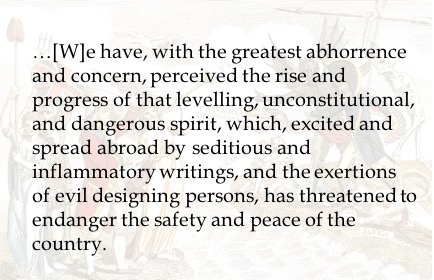
“That we have, with the greatest abhorrence and concern, perceived the rise and progress of that levelling, unconstitutional, and dangerous spirit, which, excited and spread abroad by seditious and inflammatory writings, and the exertions of evil designing persons, has threatened to endanger the safety and peace of the country.
“In these circumstances, we consider it to be our duty, as good citizens, and especially as a Society instituted for the civilization and improvement of large and distant districts of the country, far removed from the feats of political information, to embrace the opportunity afforded us, by our present meeting, of expressing our loyalty to our most gracious Sovereign ; our inviolable attachment to our free and happy constitution, on the true principles of the revolution settlement in 1688 ; our firm determination to protect it at the risque of our lives, and fortunes, from every attack from republicans, and levellers : trusting to the inherent powers, and energy of the constitution itself, and to the wisdom of Parliament, for every thing that may be necessary to secure it against internal lapse, or decay, and to transmit it unimpaired to the latest posterity.
“For these purposes, while we resolve to afford every assistance in our power to the civil magistrates, in all their lawful and constitutional exertions, for preserving public tranquility ; we are also determined to use our utmost endeavours to prevent this unhappy spirit, which at present prevails in so many other places, from being attempted to be introduced, by seditious and designing men, into those parts of the country, which are the object of our attention, in our associated capacity ; and though we are thoroughly convinced that the loyalty of the Highlands of Scotland ; and the attachment of its inhabitants to our happy constitution, are not to be shaken, or impaired by such means ; yet, we feel it our duty, while these dangerous doctrines are so industriously and artfully disseminated, to express our firm resolution, by every means in our power, to cultivate and preserve in their minds, those sentiments of loyalty, and subordination to legal government, and that love of peace and good order, on which their prosperity and happiness so particularly depend.” (1)
~~~
(1) Highland Society of Scotland, Prize Essays and Transactions of the Highland Society of Scotland [etc.] (Vol. I.) (Edinburgh: C. Stewart, Printer to the Society), 1799), tdd xliii-xlv.
(2) Ma tha an t-eadar-theangachadh Gàidhlig fhathast ann, cha do lorg mi e. Leig fios thugam ma tha thu air fhaicinn!
Tha an tagairt gun deach eadar-theangachadh agus a sgaoileadh mar fhrith-phropaganda ri lorg ann am Fredrick Albritton Jonsson, Enlightenment’s Frontier: The Scottish Highlands and the Origins of Environmentalism (New Haven & London: Yale University Press, 2013), tdd 214-215. B’ iad na tùsan a bha aigesan: NAS [=NRS], RH4/188/1, “Sederunt Book 2,” 244–46, 253–54, 265, “Sederunt Book 3,” 18, 123, 137–41, 213.
(3) Highland Society, ibid., tdd xlvii-xlix.

 A’ Cheàrdach